
Water Neutrality 101: What Sussex North Developers Must Prove
Published: 9th October 2025
Author: Sussex Water Neutrality Team
Estimated read time: 6 minutes
💧 What does “water neutrality” actually mean?
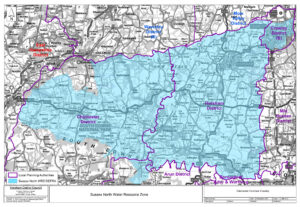
“Water neutrality” means that any new development must not increase overall demand for water within the Sussex North Water Supply Zone. In other words, any extra water used by new homes, workplaces, or infrastructure must be offset by reductions elsewhere in the same zone.
This policy emerged after Natural England’s 2021 Position Statement found that abstraction in the Sussex North Zone could be harmingsensitive habitats in the Arun Valley SPA/SAC/Ramsar sites. It’s now a mandatory planning consideration across Horsham, Crawley, Chichester, and parts of Arun and Mid Sussex.
(Natural England 2021 PDF)
🏗️ When do you need a Water Neutrality Statement?
If your development adds new water demand — for example, new dwellings, commercial space, schools, or care homes — you must provide a Water Neutrality Statement with your planning application.
You may be exempt if:
- It’s a householder or minor application that doesn’t materially raise water use; or
- You can demonstrate zero new demand (e.g. demolition and rebuild with no occupancy increase).
- Our website has more on Water neutrality and local policy on the following page… https://sussexwaterneutrality.co.uk/planning-policy-water-neutrality-in-sussex/
Each local authority screens applications differently, so check their guidance:
⚙️ What must a Water Neutrality Statement include?
A good submission clearly sets out:
- Baseline demand — how much water the site currently uses.
- Future demand — projected use once developed (based on occupancy and fixture efficiency).
- Mitigation measures — how you’ll reduce, reuse, and offset water to achieve net zero.
🪜 The three-step hierarchy: Reduce → Reuse → Offset

1. Reduce
Design for efficiency first:
- Ultra-low-flow taps, showers, and dual-flush WCs
- High-efficiency appliances
- Leak detection and smart metering
- Behavioural nudges for residents
Local councils recommend designing to 85 litres per person per day, better than the national 110 L/p/d.
(West Sussex County Council)
2. Reuse
Capture and recycle:
- Rainwater harvesting for irrigation or WC flushing
- Greywater systems for washing machine or toilet reuse
3. Offset
If residual demand remains, developers can contribute to an offsetting or certification scheme such as the Sussex North Water Certification Scheme (SNWCS).
These funds retrofit existing homes or buildings with water-saving measures to balance the new consumption.
(Horsham District Council SNWCS)
⚖️ The legal position: backed by the High Court
A 2024 High Court ruling confirmed that councils can lawfully refuse applications which fail to prove water neutrality. (Cornerstone Barristers, 2024)
This means that water neutrality is now a legally enforceable constraint, not just guidance.
Developers who ignore it risk refusal or judicial review.
🧮 Practical tips for developers

- Involve water engineers and ecologists early.
- Base calculations on credible occupancy data and verified appliance ratings.
- Provide detailed design drawings for any reuse systems.
- Quantify every offset measure — avoid vague promises.
- Keep correspondence with Southern Water and your local authority as evidence.
- If your project needs to purchase water credits to obtain water neutrality for planning permission was can provide this – https://sussexwaterneutrality.co.uk/buy-water-credits/
🌱 Why this matters
The Sussex North zone’s water comes mainly from groundwater abstraction connected to the Arun Valley wetlands. Over-extraction could harm rare bird and plant species.
By enforcing neutrality, local authorities aim to allow growth while protecting these internationally important habitats.
🗺️ Useful resources
- West Sussex County Council — Water Neutrality Hub
- Southern Water — Developer Guidance
- Horsham DC — SNWCS Scheme
- Natural England — 2021 Position Statement (PDF)
❓ FAQs
What is water neutrality?
Water neutrality means any new development must not increase total water use in the Sussex North Zone. Any extra demand must be balanced by savings elsewhere.
Does every project need a Water Neutrality Statement?
Most that increase mains-water demand do. Check with your local authority; small domestic works are often exempt.
How can developers offset their water use?
By contributing to or delivering verified water-saving measures within the same zone — for example, retrofitting older housing stock with efficient fixtures.
Who manages the Sussex North offsetting scheme?
The Sussex North Water Certification Scheme (SNWCS) is being coordinated by local authorities with input from Southern Water and Natural England.
⚠️ Disclaimer
This article summarises public policy and planning guidance as of October 2025. It is for general information only and does not constitute legal or planning advice. Developers should consult the relevant planning authority or a qualified planning consultant.